
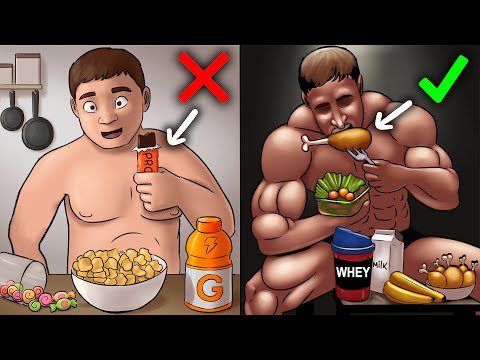
These are the best post-workout foods that you can eat to maximize muscle growth and recovery. Before you make your next post-workout meal make sure you watch this video. Whether you’re trying to burn fat and lose weight or build muscle what eat after a workout will either help or hurt your progress.
🔥 FREE 6 Week Shred:
📲 FREE Diet/Workout Planner Tool:
The recovery and repair process after a workout is just as important as the workout itself. During your workout, you’ll create tiny tears in the muscles, and ultimately the goal is to have your muscles come back stronger and bigger as they heal. However, the only way that you’ll reap the benefits from your workout and build muscle is by providing your body the resources it needs to recover, and there’s no doubt that some options are significantly better than others post-workout… So I want to give you guys 10 of the best foods that you should have after a workout. And the first category that I’m going to list some options for is of course protein.
It’s essential to consume protein around your workouts because the amino acids found in protein are the building blocks to your muscles. In fact, building muscle is all about creating a “positive protein turnover rate.” This means that your body has to add more amino acids to a muscle than the amount that gets broken down regularly. Now, most of you have probably heard of the anabolic window, which is a myth, that suggests that you need to get your protein shake in as fast as possible after a workout. Even though it’s not true that you need to take in protein IMMEDIATELY after a workout a good guideline is to try to get at least a minimum of twenty grams of protein within an hour and a half of finishing your workout. Keep in mind If you happen to train in a fasted state as I do, it’s better to have that protein sooner rather than later because there will be fewer amino acids circulating through your body since you didn’t eat any protein before your workout. On the other hand, if you did eat and you had a lot of protein before your workout you can probably get away with extending that time-frame even past the 1 1/2 hour mark, but taking down protein within 1 1/2 hours after finishing your workout is generally a good guideline to aim for.
So the first and one of the best protein sources post-workout is whey protein. Whey is a fast-digesting protein source, which is especially beneficial if you train on an empty stomach. That’s because it’ll digest quickly and cause a rapid spike in amino acids that will quickly become available for your body to use for muscle repair and recovery. So as a result, whey protein will stimulate protein synthesis which is the build-up of new muscle fibers, and it’ll do it faster than slower-digesting protein sources like casein. (1) The best part about whey protein is that it’s one of the world’s best sources of leucine, which happens to be the most important amino acid for muscle growth. This is because leucine activates mTOR, which is the primary muscle-building pathway in the body. That’s why simply having a whey protein shake can be an excellent post-workout protein source, especially if you’re short on time.
Now even though casein isn’t the best protein source if you train fasted, it still has a similar nutrition profile to whey, however, casein does have other qualities that may make it an even better choice if you don’t train on an empty stomach. This is because whey is actually not as effective as casein at preventing muscle protein breakdown. (2) And remember to build muscle we want to do both reduce muscle protein breakdown and increase muscle protein synthesis. Casein may also be more beneficial for fat loss, due to the fact that it digests slower. This helps you feel full for longer. In a study (3) where they compared people that took either a casein supplement, a whey supplement, or a placebo after weight training the researchers found that Not only did the casein group experienced more than double the amount of muscle growth compared to the whey group, but they also lost twice the amount of fat. (4) So for all of you that have a pre-workout meal and don’t train fasted you may want to take a closer look at casein instead of whey post-workout.
Now since casein and whey are both good choices post-workout it should come as no surprise that milk is also a great option. This is because both casein and whey are derived from cows’ milk. And based on the available research, milk does seem to be an equally excellent option. For example, in a study published just a few years ago, researchers found that drinking whole milk stimulated muscle protein synthesis to a similar degree as whey protein. (7) Interestingly enough, research shows that whole milk stimulates muscle protein synthesis better than skim milk, even when whole milk contains less protein than skim milk. (8) So, if you want to boost muscle growth and recover…


References
1. Whey protein stimulates protein synthesis (the build-up of new muscle fibers) faster than slower-digesting protein sources like casein.
https://pubmed.ncbi.nlm.nih.gov/21795443/
2. While casein is decent at reducing protein breakdown, whey isn’t effective in that regard.
https://www.pnas.org/content/94/26/14930
3. Casein is superior for gaining strength and muscle compared to whey, as shown by a study published in the Annals of Nutrition and Metabolism.
https://www.karger.com/Article/Abstract/12817
4. “Lean mass gains in the three groups did not change for diet alone, versus gains of 4 ± 1.4 and 2 ± 0.7 kg in the casein and whey groups, respectively.”
https://www.karger.com/Article/Abstract/12817
5. “Mean increase in strength for chest, shoulder and legs was 59 ± 9% for casein and 29 ± 9% for whey, a significant group difference.”
https://www.karger.com/Article/Abstract/12817
6. “This significant difference in body composition and strength is likely due to improved nitrogen retention and overall anticatabolic effects caused by the peptide components of the casein hydrolysate.”
https://www.karger.com/Article/Abstract/12817
7. In a study published in the journal Nutrients found that drinking whole milk stimulated muscle protein synthesis to a similar degree as whey protein.
https://www.ncbi.nlm.nih.gov/pmc/articles/PMC4632440/
8. Whole milk stimulates muscle protein synthesis better than skim milk, even when the whole milk contains less protein than the skim milk.
https://pubmed.ncbi.nlm.nih.gov/16679981/
9. Up to around 50% of raw eggs’ protein is not absorbed or digested in the small intestine.
https://academic.oup.com/jn/article/128/10/1716/4723080
https://journals.physiology.org/doi/full/10.1152/ajpgi.1999.277.5.G935
10. This includes lowering cortisol, increasing testosterone, reducing muscle protein breakdown, boosting muscle protein synthesis, and increasing nutrient partitioning.
https://www.jssm.org/abstresearchajssm-15-176.xml.xml
https://www.ncbi.nlm.nih.gov/pmc/articles/PMC2958879/
https://pubmed.ncbi.nlm.nih.gov/12909818/
https://www.mdpi.com/2072-6643/5/2/509
https://pubmed.ncbi.nlm.nih.gov/21501117/
11. Insulin suppresses muscle protein breakdown, and to reap the maximum effects, you’ll have to trigger an insulin concentration of 11, 15, or 30 mU/I, depending on the study that you look at.
https://pubmed.ncbi.nlm.nih.gov/21131864/
https://pubmed.ncbi.nlm.nih.gov/16365095/
https://pubmed.ncbi.nlm.nih.gov/18577697/
12. If you create such an elevation, such as by consuming 100 grams of carbs, you will reduce muscle protein breakdown after a workout, according to a study published in the Journal of Applied Physiology.
https://pubmed.ncbi.nlm.nih.gov/14594866/
13. “There’s a “super-compensation” of glycogen stores when carbohydrate is consumed shortly post-exercise. And delaying their consumption by just 2 hours reduces the rate of muscle glycogen re-synthesis by as much as 50%.”
https://pubmed.ncbi.nlm.nih.gov/9694422/
14. Multiple studies show that consuming tart cherry after resistance training reduces muscle protein breakdown and muscle soreness while speeding up recovery.
https://www.ncbi.nlm.nih.gov/pmc/articles/PMC4271620/
https://pubmed.ncbi.nlm.nih.gov/26578852/
https://pubmed.ncbi.nlm.nih.gov/21233776/
15. Tart Cherry Juice – “Attenuate muscle soreness, strength decrement during recovery, and markers of muscle catabolism in resistance-trained individuals.”
https://pubmed.ncbi.nlm.nih.gov/26578852/
16. As an alternative to tart cherry juice, watermelon juice is also a carb-rich food source that may benefit workout recovery, as shown by a study published in the Journal of Agricultural and Food Chemistry.
https://pubs.acs.org/doi/abs/10.1021/jf400964r
17. “[Watermelon] Helped to reduce the recovery heart rate and muscle soreness after 24 h.”
https://pubs.acs.org/doi/abs/10.1021/jf400964r
18. For instance one study found that a 5% dehydration significantly reduced testosterone secretion after resistance training while increasing cortisol and norepinephrine.
https://pubmed.ncbi.nlm.nih.gov/18617629/
I appreciate you for all this explanation much appreciated ❤
If you’ve been wondering why you’re not feeling as strong, motivated, or sharp as you used to, Testosterone Rewired by David Brooks might just have the answers. The book focuses on the power of testosterone and how increasing it can seriously transform your health and mindset. If you’re tired of feeling drained or out of balance, this book offers some solid advice on how to get back to your peak
i will try to change my appearance by doing it in the house with dumb bells and weights…ill come back if it is good the result…
Can never have too much sa-tan